


Procedural consequences for the parties to the trial in case of failure to appear at the court session when considering the case in the district court or courts of economic and administrative jurisdiction. What should be taken into account if, for some reason, it is not possible to appear in court?
Reasons for not appearing in court
To begin with, it is necessary to clearly distinguish the general thesis related to the non-appearance of a party to the trial at the court session, depending on the reasons for such non-appearance:
- deliberate non-appearance of a participant to solve their own problems within the framework of the process or abuse of procedural rights;
- failure to appear due to independent circumstances, which does not imply abuse of procedural rights;
- failure to appear due to the impossibility of notifying the party of the holding of the court session.
Depending on the nature of the reasons for non-appearance, the interested party can build an appropriate legal position regarding the trial as a whole or make a situational decision regarding its own position within a particular court session regarding the procedural behavior of the party that did not appear for consideration of the case.
The procedural responsibility of the parties in the context of court appearances is designed to provide adequate opportunities for the court to fully and objectively consider the case, and therefore is an important element of the judicial process and the court is obliged to make efforts to force the parties to discipline in this context.
General types of consequences for failure to appear depending on the jurisdiction and jurisdiction of the court case
In most cases, there is procedural liability for a party’s failure to appear at a hearing. For participants with mandatory participation, legal liability is provided.
- For the Claimant, failure to appear at 2 or more court sessions has consequences in the form of closing the case and leaving it without consideration in accordance with Article 257 of the Code of Civil Procedure of Ukraine, which states that the Court issues a Ruling on leaving the application without consideration if the Claimant did not reappear properly at the court session, if he did not submit an application for consideration of the case in his absence.
A similar procedure is typical for all types of cases in relation to jurisdiction. The basic duty of the Plaintiff is not only to file a claim, but also to participate directly in the process. At a minimum, the Claimant is required to notify the court at each hearing of the reasons for the failure to appear. - For the Respondent, failure to appear at 2 or more court sessions, subject to the appearance of the Claimant, may have consequences in the form of a decision in absentia on the case without his participation. A decision in absentia is established and issued in accordance with the requirements of Article 280-289 of the Code of Civil Procedure of Ukraine, and is drawn up according to the general rules of this type of decisions.
At the same time, it is no secret that very rarely such decisions in absentia are made in favor of the Respondent, and accordingly, it is wrong to believe that ignoring the trial will be in his interests. - If all the Parties do not appear for participation in court sessions (failure to appear for 2 or more court sessions), then the rule associated with the absence of the Claimant is applied, namely, the closure of the civil case and leaving it without consideration in accordance with Article 257 of the Code of Civil Procedure of Ukraine.
- Different consequences apply to Third Parties who do not appear at court hearings, depending on the circumstances of the case being examined. So, for example, if a Third Party is involved in the case, and his testimony, testimonies, or certain physical evidence that only this Third Party can provide and which are essential in the case, or make it impossible to consider the case without providing such evidence, then to the Third Party certain means of “encouragement” in the form of administrative fines, etc. may be applied. Also, the Court may consider the case without the participation of a Third Party (the most common case).
In most business cases, participation in the case is a right and not an obligation, and therefore the listed consequences also apply.
The obligation to appear in court is specified in the court ruling on the appointment of a hearing in the case, which indicates what the party must comply with in the framework of the trial and the consequences for failure to comply.
In administrative cases, the participation of the defendant is associated with the need to provide various kinds of information regarding the essence of the dispute. For example: registration file of a legal entity from the register of legal entities; registration file of a real estate object from the real estate register, the BTI register; etc. Accordingly, a public authority, a notary or another subject of authority is obliged at least to transfer these materials to the court, since without them it is impossible to consider the case.
Consequences of non-appearance depending on the procedural status of the participants in the court
In order to form a common understanding regarding the consequences of non-attendance, one can refer to the Civil Codes, which are the main governing Laws. Economic and administrative legislation may differ in some nuances (which is described in other sections of the article).
When resolving issues related to legal relations that arise between the parties on the grounds provided for in civil proceedings, the court is guided by and proceeds from the provisions of the Code of Civil Procedure of Ukraine, noting the main provisions that participants in the court case need to know.
In this regard, when accepting a case for consideration, the general consequences of a party’s failure to appear are usually indicated by the court in the Ruling “on opening court proceedings in a specific case” and instructions regarding the rights and obligations of participants in the trial, which the court sends to participants along with a notice of the date of the trial . The participant in the trial can be guided by these documents in the context of liability for non-appearance and get acquainted with them in a timely manner. Similar provisions are enshrined in Article 129 of the Code of Civil Procedure of Ukraine.
For the parties (Claimant, Respondent) there may be the following types of consequences:
- Failure to appear in 1 court session with good reasons or without good reasons, in most cases, will result in the postponement of the court hearing to another date.
An exception to this rule may be the presence of previous abuses by the party that did not appear at the hearing (failure to appear for 2 or more meetings). - in case of non-appearance for 2 court sessions in a row, it is necessary to understand the reasons for the non-appearance:
- if there are valid reasons, it is possible: 1) to postpone the meeting to another date; 2) consideration of the case without a participant. This issue takes into account: the degree of validity of the reasons for non-appearance (to what extent the reasons actually prevented the participation of the party in the case and whether the party could objectively overcome them); the previous behavior of the party and the materials that were provided to her in court; the objective need for the direct participation of the parties in the consideration of the case.
Here, it should be noted that the court takes into account the reasons as valid, only when submitting an appropriate petition for the meeting, in which such reasons are indicated. Failure to appear without a request is considered “absence without good reason”. - if there are no good reasons: 1) postponement of the meeting to another date; 2) consideration of the case without a participant. This issue also takes into account: the degree of validity of the reasons for non-appearance; the previous behavior of the party and the materials that were provided to her in court; the objective need for the direct participation of the parties in the consideration of the case.
An important factor is the availability of notice of delivery of the agenda to the absent party for this meeting and the previous one as well. If the party was notified twice, then most likely the case will be considered without its participation, the procedural form of the consequences of failure to appear in this case will be the fact established by the court of unfair behavior of the absent party, which often leads to a more unfavorable court decision. If the attendance of the meetings is ignored by the plaintiff, then the case may be left without consideration and the claim returned.
- if there are valid reasons, it is possible: 1) to postpone the meeting to another date; 2) consideration of the case without a participant. This issue takes into account: the degree of validity of the reasons for non-appearance (to what extent the reasons actually prevented the participation of the party in the case and whether the party could objectively overcome them); the previous behavior of the party and the materials that were provided to her in court; the objective need for the direct participation of the parties in the consideration of the case.
- in case of failure to appear at the 3rd court session in a row, in most cases, the case is considered without the absent participant (including making a decision in absentia).
This order is taken into account in the conscientious behavior of the 2nd party. In practice, combinations are possible depending on the behavior of the parties and the circumstances of the case.
Third parties without independent claims (not interested in resolving the case on the merits) in most cases bear the same responsibility as the Respondent.
For participants who are required to participate in the trial, additional liability is provided for under the Code (applies to experts, witnesses, third parties with a mandatory presence established by law). The issue related to their obligations in the process is not taken into account and should be considered separately.
The above norms, as their purpose, should discipline the behavior of the Parties to the trial, stimulating them to the proper execution and implementation of procedural rights and obligations.
Reasons for the importance of missing a court session and serving subpoenas
When deciding the issue related to the consequences of the non-appearance of the Parties to participate in the case, the Court also takes into account the following:
- The reasons for the importance of “skipping” the participation of the Claimant in the court session during the consideration of the case, provided that he is notified of the time and place of the court session, may not be clarified. As noted by the High Specialized Court of Ukraine for the consideration of civil and criminal cases in an information letter dated May 14, 2012, “according to the requirements of the Code of Civil Procedure of Ukraine, the Court should not find out the reasons for the repeated failure to appear by the properly notified Claimant about the court session and this cannot be a basis for canceling the adopted them of the Decisions on leaving the application without consideration”. Thus, when leaving the statement of claim without consideration due to the Plaintiff’s missing 2 or more court sessions, with a possible appeal of the Resolution “on leaving the statement of claim without consideration”, the claims of the Claimant’s Party to the Court that “the Court supposedly should have establish the impossibility of participation of the plaintiff” will not be taken into account. It should also be taken into account that the Code of Civil Procedure of Ukraine obliges the parties and other persons participating in the case to inform the Court about the reasons for not appearing at the hearing. If the Court fails to report the reasons for non-appearance, it is considered that the parties and other persons participating in the case did not appear at the court session “without good reason”.
- The court may take into account certain reasons as valid, if at the court session the party filed an appropriate application indicating the reasons that make it difficult for the Party to participate in the court session, in particular: an application for consideration of the case in the absence of the Claimant at the court session, applications for changing the location of the Claimant, etc. n. In case of abuse of such statements and non-participation of a person in the meetings, an appropriate investigation may be applied in accordance with Article 44 of the Code of Civil Procedure of Ukraine, in connection with the abuse by the Party of its rights, which is also enshrined in paragraph 11, part 3, article 2 of the Code of Civil Procedure of Ukraine.
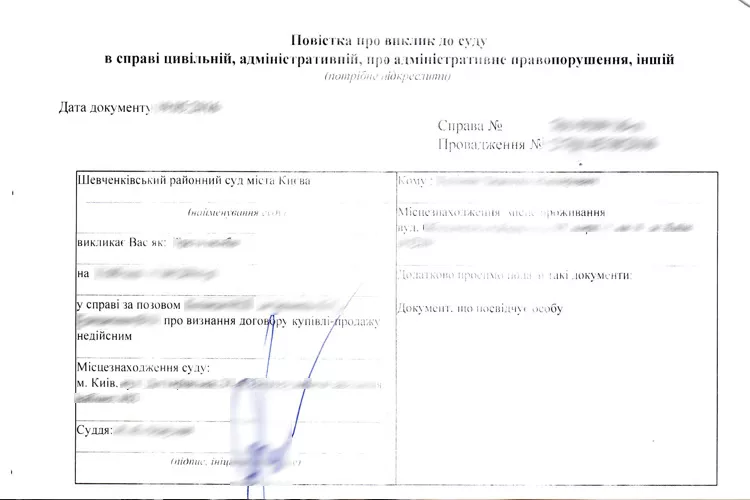
- A person’s notice of participation in a court session must be drawn up in accordance with the requirements of the Law. Thus, in accordance with Articles 128-132 of the Code of Civil Procedure of Ukraine, the court summons together with a receipt, and in the cases established by this Code, together with copies of the relevant documents, is sent by registered mail with notification or through couriers to the address indicated by the party or another person, participating in the case. In the absence of the persons participating in the case at such address, it is considered that the court summons or court notice has been duly served on them. The persons participating in the case, as well as witnesses, experts, specialists and translators, may be notified or summoned to the Court by telegram, fax or other means of communication that ensure the recording of the message or call. This takes into account the provision according to which the Parties and other persons participating in the case are obliged to inform the court about a change in their place of residence (stay, location) or location during the proceedings. In the absence of an application for a change of residence or location, the summons is sent to the last address known to the Court and is considered delivered, even if the person at that address no longer lives or is not there.
- According to part 5 of Article 130 of the Code of Civil Procedure of Ukraine, the service of a court summons to a representative of a Party participating in the case is considered to be the service of a summons to that party.
When deciding on the issue of leaving the case without consideration, the Court draws up an appropriate decision in the form of a Resolution “on leaving the statement of claim without consideration.”
When a decision is made in absentia, it is drawn up in accordance with the general requirements for this type of decisions, indicating in the decision the information that it is adopted “in absentia”.
Return to content in article:
- Reasons for not appearing in court
- Types of consequences for failure to appear depending on the jurisdiction and jurisdiction of the court case
- About the consequences of non-appearance depending on the procedural status of the participants in the court
- About the reasons for the importance of skipping a court session and serving subpoenas

Leave a Reply
You must be logged in to post a comment.